
A Neural Learning-Based (NLB) First Ray Control Protocol
A standardized neuromuscular training framework for active foot control in rehabilitation.
Improve foot posture, balance, gait mechanics, and athletic movement through structured first ray control retraining.
.jpg)
Differentiating “Good” Flat Foot and “Bad” Flat Foot
Not all flat feet are the same. A low arch alone does not automatically mean a person has a problematic foot condition.
The key factor is not just the appearance of the arch, but whether the foot can maintain good dynamic control, balance, and function during movement.
Good Flat Foot
A “good flat foot” refers to a foot with a lower arch appearance, but with relatively stable mechanics and good
functional control.
Characteristics commonly include:
-
Minimal overpronation
-
Minimal calcaneal valgus (heel collapse)
-
Good balance during single-leg stance
-
Functional windlass mechanism during walking
-
Good confidence in sports participation
-
No frequent falls, joint aches, or movement difficulties
-
Ability to run, jump, and squat normally
In this group, the foot is still able to absorb and release forces efficiently during walking and running.
Although the arch appears lower, the overall biomechanics and dynamic stability remain functional.
.jpg)
Bad Flat Foot
A “bad flat foot” is not just a low arch appearance, but a condition where the foot loses dynamic control and stability.
Characteristics commonly include:
-
Significant overpronation
-
Obvious calcaneal valgus
-
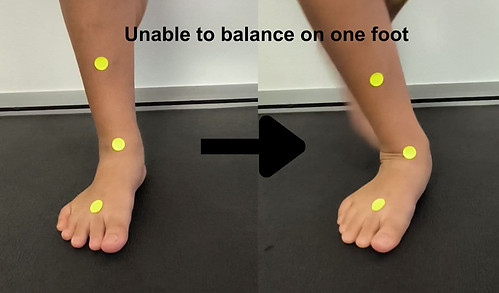
Poor balance during single-leg stance
-
Poor or absent windlass mechanism during walking
-
Reduced confidence during sports participation
-
Complaints of fatigue or joint aches
-
Overall instability, or frequent tripping
-
Difficulty with running, jumping, or prolonged walking
These findings indicate excessive shifting of the body’s centre of gravity and poor control of force transfer through the foot.
The foot becomes less efficient during movement, causing the body to compensate through other joints and muscle groups.
Why “Good” Flat Foot Usually Does Not Need Treatment, But “Bad” Flat Foot Does
A good flat foot is primarily an appearance variation rather than a functional problem.
Since the person still demonstrates good dynamic balance, efficient walking mechanics, and strong movement capability, the likelihood of future disability or functional limitation is relatively low.
In contrast, a bad flat foot already shows signs of functional impairment, even if the person is not currently experiencing severe pain.
Children with poor foot control often:
-
Avoid running and jumping
-
Fatigue more easily
-
Develop lower confidence in sports
-
Become progressively less active

Over time, reduced activity may contribute to poorer muscle development, worsening movement quality, and increasing stiffness as the musculoskeletal system matures.
Early childhood is a critical period for motor learning and movement adaptation.
Once skeletal maturity and long-term compensation patterns develop, improving foot mechanics may become significantly more difficult.
For this reason, treatment should not only focus on pain, but also on restoring healthy movement quality and long-term physical function.
Are Short Foot Exercise, Towel Curl, and Toe Walking Sufficient?
Many conventional flat foot exercises focus mainly on static arch formation or toe strengthening.
While these exercises may have limited value in certain situations, they often do not adequately prepare the foot for real-life dynamic movement such as walking, running, jumping, and sports participation.
Short Foot Exercise
The short foot exercise mainly teaches a person to stiffen and elevate the arch in a static posture such as sitting or standing.
However, walking and running are dynamic activities involving:
-
Energy absorption during loading
-
Energy release during push-off
A foot that is only trained to become stiff may struggle to adapt efficiently during dynamic movement.
The exercise does not sufficiently train how the foot should absorb force, transition body weight, and release energy throughout a full gait cycle.

Towel Curl Exercise
Towel curl mainly trains toe flexion strength.
Conceptually, this may not fully reflect normal walking mechanics because during toe-off, the toes should naturally move into extension rather than flexion.
In many individuals with flat feet:
-
Toe flexor muscles are already overactive
-
Intrinsic arch stabilisers are relatively weak
Overemphasising toe flexor dominance may further suppress proper arch muscle activation and movement coordination.
Toe Walking
Toe walking places the foot primarily in a tiptoe posture.
While it may strengthen parts of the calf and forefoot, it does not adequately train the foot through the complete gait cycle, including:
-
Heel rocker
-
Ankle rocker
-
Forefoot/toe rocker
Walking and running require controlled transitions across multiple foot positions, not simply remaining on the toes.
Excessive focus on toe-dominant movement may again reinforce overactivity of toe flexors without restoring proper dynamic arch control.
Why Not Just Use Foot Orthoses?
Foot orthoses can provide temporary support and may reduce symptoms in selected cases.
However, orthoses do not teach the foot how to actively regain motor control.
The foot is a highly dynamic structure:
-
It becomes flexible during loading
-
It stiffens during push-off
A foot orthosis, however, has a fixed shape and cannot dynamically adapt like the human foot.
If an orthosis is made too rigid:
-
Natural foot movement becomes restricted
-
Muscle activity may reduce over time
-
Long-term dependency may occur
If the orthosis is too loose:
-
Structural correction becomes minimal
-
Excessive arch collapse may still occur
Furthermore:
-
Orthoses are generally less suitable for high-intensity sports requiring natural foot mechanics
-
They mainly work with closed footwear
-
They are impractical in many cultures where shoes are not worn indoors
From a rehabilitation perspective, assistive devices are ideally temporary tools rather than permanent lifelong dependence.
Long-term orthotic reliance may be appropriate only when improvement potential is severely limited, such as:
-
Structural bone deformity
-
Neurological injury
-
Brain injury or stroke
-
Severe motor learning limitations
For individuals with flexible flat feet and intact learning capacity, improving active motor control may offer a more functional long-term approach.
Why Professionals Need to Learn the Neural Learning–Based First Ray Control Training Protocol
The Neural Learning–Based First Ray Control Training Protocol was developed to address a major gap in conventional flat foot rehabilitation: the lack of structured progressive dynamic motor retraining.
According to the inventor’s academic literature review and global novelty search conducted by an appointed IP agent, no existing protocol was identified that provides a complete progressive framework from:
-
Non-weight-bearing training
-
Sitting control
-
Standing control
-
Walking retraining
-
Squatting
-
Jumping
-
Running
Conventional approaches often focus heavily on restriction, support, or static strengthening, and many individuals with flat feet are advised to avoid high-intensity sports altogether.
In contrast, this protocol aims to restore dynamic movement quality and confidence progressively.
Individuals who successfully complete the program are encouraged to participate actively in running and jumping activities to reinforce healthy motor patterns and maintain long-term neuromuscular adaptation.
The protocol emphasises:
-
Dynamic first ray control
-
Windlass mechanism optimisation
-
Balance and force transfer
-
Progressive movement learning
-
Real-world functional performance
Rather than merely creating an arch appearance, the objective is to restore efficient movement mechanics that can support long-term physical activity and sports participation.